My Strategy | Beating Circumstantial Evidence
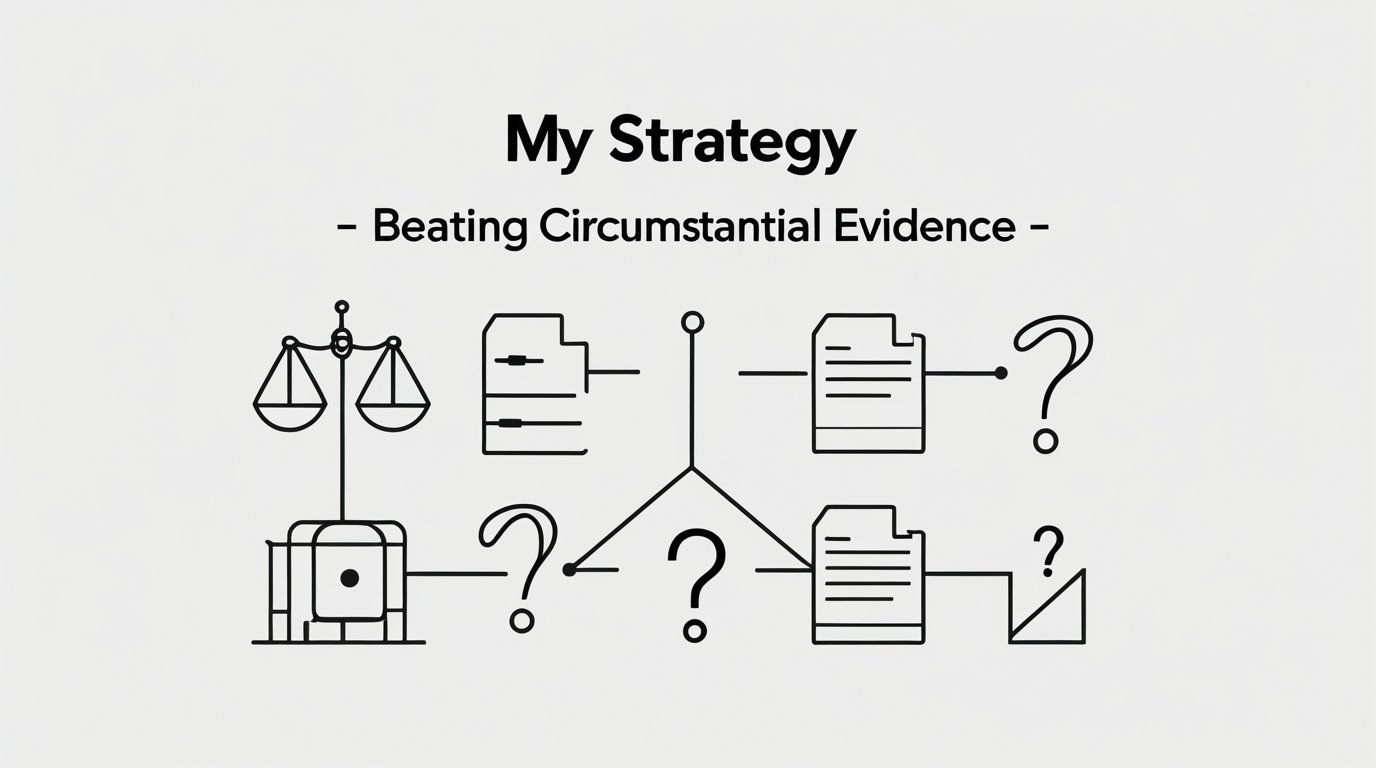
If you believe everything you see on Law & Order, you’d think every trial ends with a witness sobbing a confession or a DNA test that arrives in a glowing briefcase. In the real world, I spend most of my time explaining to juries that just because my client owns a black hoodie and was seen within a five-mile radius of a crime scene doesn’t make him a mastermind criminal, it makes him a guy who shops at Gap and has a pulse. Defending a case built on circumstantial evidence is like trying to argue that a pile of Lego bricks is actually a spaceship; it’s all about how you choose to connect the dots.
1. The Hollywood Gavel vs. The Grim Reality of the Bar:
Let’s get one thing straight: the “smoking gun” is a myth. In my fifteen years of practice, I have seen exactly one smoking gun, and it turned out to be a very realistic-looking vape pen. Most of the time, the prosecution comes at me with a handful of “maybes,” a dash of “could have beens,” and a witness who hasn’t had an eye exam since the Bush administration.
The weight of a criminal defense strategy often rests on the shoulders of twelve people who would rather be anywhere else, literally anywhere, including the DMV or a root canal. My job isn’t just to “prove” innocence; it’s to show that the prosecutor’s “mountain of evidence” is actually just a very tall pile of loose sand. When you’re dealing with circumstantial evidence, you aren’t fighting facts; you’re fighting the prosecution’s imagination.
The “Chain of Steel” vs. The “String of Pearls”
In law school, they teach you about the burden of proof like it’s some sacred, immutable shield. In the courtroom, it’s a tug-of-war. The prosecution likes to present their case as a “string of pearls”, if you have enough small, shiny pieces of evidence, they eventually form a beautiful, cohesive necklace of guilt.
My strategy? I treat it like a “chain of steel.” If I can snap just one link, if I can show that the “pearl” of the defendant’s cell phone pings is actually a flawed piece of data, the whole thing falls apart. You don’t have to disprove the entire story; you just have to prove that the story is missing a critical chapter. This is the cornerstone of beating a criminal charge when there are no eyewitnesses. I’m not looking for a miracle; I’m looking for a crack in the foundation.
Direct vs. Circumstantial:
I often have to explain to clients (and occasionally to grumpy judges) the difference between direct vs circumstantial evidence. Direct evidence is someone saying, “I saw John pull the trigger.” Circumstantial evidence is someone saying, “I saw John running away with a gun, and then I heard a bang.”
One is a movie; the other is a puzzle. The irony? Juries often trust circumstantial evidence more because they’ve been conditioned by CSI to believe that fingerprints and “pings” are infallible. Part of my lawyer’s perspective on trials is spent deprogramming the jury. I have to remind them that fingerprints don’t come with a timestamp. My client’s DNA being on a doorknob doesn’t mean he committed a burglary; it means he’s visited his friend’s house in the last six months.
The Prosecution’s Narrative:
Prosecutors are, essentially, failed novelists. They take a few disparate facts and weave a tale of greed, passion, and betrayal. They’ll point to my client’s Google search for “how to get blood out of a rug” as proof of a murder, ignoring the fact that my client owns a 140-pound Great Dane with a weak stomach.
When beating circumstantial evidence, my first move is always the “Deconstruction.” I take their narrative, and I strip it of its adjectives. “The defendant suspiciously fled the scene” becomes “The man walked toward the bus stop.” By removing the emotional “flavoring” the prosecution adds, I force the jury to look at the dry, boring, and often innocent reality of the facts. This is where legal defense tactics meet psychology. If you can change the “vibe” of the evidence, you can change the verdict.
The “Alternative Theory” Weapon:
If I stand in front of a jury and just say “My client didn’t do it,” I’m going to lose. Humans are wired for stories. If the prosecution tells a story where my client is the villain, I have to tell a story where the evidence points toward someone else, or toward a series of unfortunate coincidences.
A successful criminal defense strategy involves providing an “Alternative Narrative.” I don’t need to prove the alternative narrative is true beyond a reasonable doubt; I just need to show it’s possible. If I can provide a plausible explanation for why his car was on that street that night that doesn’t involve a heist, I’ve already won. I’m planting seeds of doubt in a garden that the prosecution thought they had paved over with certainty.
The Only Friend I Have Left:
We talk about reasonable doubt so much that it has become a cliché, but it is the only thing standing between my client and a very unpleasant orange jumpsuit. I like to tell juries that “reasonable doubt” isn’t a technicality, it’s the highest standard in our civilization for a reason.
When the case is purely circumstantial, the burden of proof is actually higher in practice, even if the law says otherwise. If there’s no “smoking gun,” the prosecution has to prove that no other reasonable explanation exists. My job is to be the “Reasonable Explanation Generator.” I am the guy who says, “But what if…?” Until that “what if” is answered, the jury cannot, in good conscience, convict.
2. The “CSI Effect” and the Forensic Fallacy:
One of the biggest hurdles I face in modern courtrooms is what we call the “CSI Effect.” Thanks to twenty years of television procedurals, every juror enters the box expecting a high-resolution, 3D-mapped recreation of the crime scene that identifies the perpetrator via a stray eyelash. When they don’t get it, they get cranky. But when the prosecution does provide forensic evidence reliability reports, they treat it like gospel.
My job is to remind them that forensics is performed by humans, and humans are notoriously messy. I once had a case where a “match” on a partial fingerprint was the cornerstone of the prosecution’s argument. In their narrative, it was an unbreakable link. In reality, that “match” was based on a smudge that looked like it could have belonged to my client or a particularly talented primate. By challenging the forensic evidence’s reliability, I’m not saying the science is wrong; I’m saying the application of that science is often biased. If the lab technician knows who the prime suspect is before they run the test, the “match” is already halfway decided.
Cross-Examining the “Expert” (Or: How to Make a Scientist Sweat):
I’ve spent a significant portion of my career cross-examining expert witnesses. These are people who have spent thirty years studying things like blood spatter patterns or soil composition. They are usually very smart, very confident, and very susceptible to their own egos. My legal defense tactics for dealing with experts aren’t about out-sciencing them; it’s about out-common-sensing them.
If I can get an expert to admit that there is even a 5% margin of error, or that a different lab might interpret the results differently, I’ve done my job. I love asking an expert, “Is it possible that this evidence could have been contaminated?” They hate that word—possible. Because in science, almost anything is possible. By the time I’m done with expert witness testimony, I want the jury to see that “expert opinion” is often just a very expensive guess wrapped in a lab coat. I’m not attacking the person; I’m attacking the certainty. In a world of circumstantial evidence, certainty is the enemy of the truth.
Cell Towers and the Art of “Close Enough”
The star witness of almost every trial isn’t a person; it’s a smartphone. The prosecution loves to use Cell Site Location Information (CSLI) to “prove” my client was at the scene of the crime. They show a map with a big red dot and say, “Behold! He was there!”
This is where digital evidence in court becomes a battlefield. I have to explain to a jury, many of whom still struggle with their own Wi-Fi passwords, that a cell tower ping doesn’t mean you were standing on a specific corner. It means you were somewhere within a three-mile radius, likely obscured by buildings, weather, or the fact that the tower was overloaded because a Taylor Swift song just dropped.
When I’m beating a criminal charge that relies on “pings,” I bring in my own experts to show how signals bounce and hand off. I turn that “precise red dot” into a vague, blurry blob that covers half the city. If my client was “in the area,” so were 40,000 other people. Suddenly, the evidence doesn’t look so “damning” anymore.
When Curiosity Looks Like a Crime:
Then there’s the search history. “How to hide a body,” “statute of limitations for arson,” or “best untraceable poisons.” If the prosecution finds these on your laptop, they think they’ve found the smoking gun.
But I know my clients. Sometimes they’re just weird. Sometimes they’re aspiring novelists. Sometimes they’re just doom-scrolling late at night. My criminal defense strategy for digital footprints is to humanize the data. I’ve had to stand in front of a judge and explain that a search for “how to dispose of a carcass” was actually a frantic attempt by a homeowner to deal with a dead deer in their pool.
The prosecution tries to establish criminal intent vs curiosity, but the line between the two is incredibly thin. Digital data is cold; it has no context. My job is to provide that context. I have to remind the jury that if we were all judged by our 3:00 AM Google searches, we’d all be serving life sentences.
The Chain of Custody:
If you want to see a prosecutor’s face turn an interesting shade of gray, ask for a detailed log of the chain of custody. This is the paper trail that shows exactly who handled the evidence from the moment it was picked up at the scene to the moment it entered the courtroom.
In theory, this should be a perfect record. In practice, it’s often a mess of missing signatures and “I thought Bob had it” excuses. If I can show that a piece of circumstantial evidence sat in an unlocked trunk for three hours or that an evidence bag was improperly sealed, I can often get that evidence thrown out entirely. It’s not “glamorous” lawyering. It’s not a dramatic speech. It’s just checking the receipts. But sometimes, a missing signature is the difference between a “guilty” and a “not guilty.”
Managing the “Vibe” of the Courtroom:
Trials are about facts, but they are also about feelings. As a lawyer, I am essentially a director of a very high-stakes play. I have to manage the “vibe” of the room. If the jury likes me, they’re more likely to listen to my “Alternative Theory.” If they think I’m a snake, they’ll convict my client just to spite me.
This is why I use humor, real, human, slightly cynical humor. It breaks the tension. It makes me a person, not just a suit. When I can make a jury laugh at the absurdity of a prosecution’s claim, I’ve already planted the seed of reasonable doubt. You can’t be afraid of something you’re laughing at. By making the prosecution’s “mountain of evidence” look like a molehill of bad luck and poor record-keeping, I’m giving the jury the permission they need to do the right thing.
3. To Speak or Not to Speak: The Terror of the Witness Stand:
One of the most agonizing decisions I make in a trial is whether to put my client on the stand. Every client thinks they can talk their way out of a paper bag. They’ve watched enough TV to believe that they’ll have a “breakthrough moment” where they explain everything and the jury applauds.
In reality, putting a defendant on the stand is like handing the prosecution a loaded gun and hoping they have bad aim. My criminal defense strategy usually involves keeping the client silent. Why? Because the prosecution doesn’t need to prove they are a bad person, they just need to catch them in one tiny, insignificant lie. Once that happens, witness credibility is dead. If you tell a jury you had eggs for breakfast when you actually had toast, the prosecution will argue that you’re clearly a serial killer who can’t be trusted. In a case built on circumstantial evidence, the less my client says, the less “context” the prosecution has to twist.
Building a Human Out of Paperwork:
When the evidence is all “stuff”, receipts, pings, and blurry photos, I have to fight back with “people.” This is where the character witness impact comes into play. I need the jury to see my client as a person with a dog, a mother, and a favorite pizza topping, not just as “The Defendant.”
I remember a case where the prosecution’s entire argument was that my client was “aggressively motivated” to commit a crime. I brought in his third-grade teacher and his local librarian. It’s hard to convince a jury that a man is a cold-blooded mastermind when a 70-year-old woman is testifying that he used to volunteer to shelve books on Saturdays. Humanizing the defendant isn’t just about being “nice”; it’s about making the prosecution’s “circumstantial narrative” feel out of character. If the “pearls” of evidence don’t match the “string” of the person’s life, the jury starts to smell a rat.
The Art of the “What If” Question:
During the trial, I am constantly hunting for the “What If.” This is the core of cross-examination strategies in a circumstantial case. I’m not looking to prove a different person did it; I’m looking to show that the evidence could mean something else.
I once had a case where a muddy footprint at a crime scene was “matched” to my client’s sneakers. On cross-examination, I didn’t argue about the mud. I asked the officer if those sneakers, a very popular brand of white Nikes, were sold at the local mall. “Yes,” I asked if that mall sold approximately 500 pairs a month. “Probably.” Suddenly, that “unique” footprint became one of ten thousand possibilities. By focusing on reasonable doubt, I turned a “match” into a “coincidence.” You don’t need a sledgehammer to break a case; sometimes you just need a very small, very persistent needle.
Connecting the Dots (Or Erasing Them):
The closing argument is where the magic happens. Or the tragedy. It’s the only time I get to stand in front of the jury and tell them exactly how to think. If the trial is a puzzle, the closing argument is the picture on the box.
My trial closing techniques involve a lot of metaphors. I like to talk about “The Ghost of the Third Option.” I tell the jury that the prosecution has given them two choices: my client is guilty, or the prosecution is incompetent. I give them a third: the prosecution is simply wrong. I remind them that circumstantial evidence is like a bridge, it only works if every single plank is solid. If I’ve spent the last three days showing them that five or six planks are rotten, I ask them if they’d be willing to walk their own family across that bridge. Usually, the answer is a resounding “no.”
Managing Client Expectations:
Behind the scenes of every “brilliant” strategy is a client who is usually vibrating with anxiety. Part of my job is legal counseling and ethics, reminding them that a “not guilty” verdict isn’t a “medal of honor.” It just means the state didn’t do its job.
I’ve had to have the “Look, the evidence looks bad” talk more times than I care to count. But that’s the beauty of our system. It doesn’t matter if it looks bad. It only matters if it is proven. My lawyer’s perspective on trials is that we are the last line of defense against “probably.” And “probably” is a dangerous word for a government to use when it’s trying to take away someone’s freedom.
4. The Longest Walk: The Agony of Jury Deliberation:
Once the closing arguments are finished and the judge reads the instructions, a process that usually lulls half the room into a light coma, the jury disappears. This is the part of courtroom procedures that no one prepares you for: the wait. It could be two hours; it could be two days.
In my early years, I’d pace the hallway like a man possessed. Now, I sit in the cafeteria and eat mediocre sandwiches. There is a “pizza rule” in the legal world: if the jury orders lunch, they’re still arguing. If they order dinner, you might as well go home and get some sleep because they’re nowhere near a decision.
During this time, I’m constantly analyzing jury psychology. Was Juror Number Four nodding because she agreed with me, or because she was trying to stay awake? Why did Juror Number Seven look at my client with what appeared to be profound disgust? The truth is, once that door shuts, all your legal defense strategies are out of your hands. You’ve built the house; now you just have to wait and see if the wind blows it down.
Silence is Never Golden:
When the buzz finally comes, that specific ring of the courthouse phone that means a verdict has been reached, your heart does a little tap dance against your ribs. We walk back into the courtroom. The client is usually shaking. The prosecutor is looking at their watch.
The jury walks in. Here’s a tip: if they don’t look at the defendant, it’s usually bad news. If they make eye contact, there’s hope. When the clerk reads “Not Guilty,” there is no swelling orchestral music. There’s just a massive, collective exhale.
For me, litigation success isn’t about a high-five in the hallway. It’s the quiet moment when I see the handcuffs come off. But even in victory, I’m reminded of the criminal law nuances that people forget, a “Not Guilty” doesn’t mean the system thinks you’re a saint. It just means the state failed to turn their “circumstantial” pile of bricks into a wall.
The Post-Trial Reality:
People think that once the trial is over, the client just skips back into their old life. That’s a lie. A trial, especially one built on scandalous circumstantial evidence, is a forest fire. Even if you put the fire out, the trees are still charred.
The client’s neighbors still whisper. Their boss still has “concerns.” This is why I take my role as a protector so seriously. My job isn’t just about the law; it’s about the person. I’ve had to help clients navigate the aftermath of a “victory” that felt a lot like a defeat. It reinforces the importance of the presumption of innocence. If we don’t guard that principle with everything we have, then the mere accusation becomes the punishment.
Why We Fight the “Probably”
Every now and then, I’ll have a colleague ask me how I sleep at night defending people where the “evidence seems so clear.” My answer is always the same: because “seems” isn’t a legal standard.
If we allow the government to lock people up because they “probably” did it, or because it “looks bad,” then none of us are safe. My strategy for beating a criminal charge isn’t about trickery or “loopholes.” It’s about holding the system to its own promises. If the evidence is circumstantial, the doubt is almost always reasonable. I sleep just fine knowing that I’m the one making sure the “maybe” never becomes a “definitely” without a fight.
The Final Summation:
At the end of the day, being a lawyer in the trenches of criminal defense is a lesson in humility. You realize that “truth” is often a matter of perspective, and “justice” is a goal we’re always chasing but rarely catch in its purest form. But as long as prosecutors are trying to turn coincidences into crimes, I’ll be there with my “Alternative Theory” and a healthy dose of skepticism.
Success in this field isn’t about being the loudest person in the room; it’s about being the one who looked at the evidence and refused to look away until every “what if” was explored. Now, if you’ll excuse me, I have another file on my desk that looks suspiciously like a novel, and I have some editing to do.
Frequently Asked Questions:
1. What exactly is circumstantial evidence in simple terms?
It’s evidence that requires the jury to make an “inference” or a logical leap to connect it to a conclusion.
2. Can someone actually be convicted on circumstantial evidence alone?
Yes, unfortunately, if the prosecution weaves those “maybe” moments into a tight enough story for the jury.
3. What is the most common mistake people make when charged with a crime?
Thinking they can “explain” the circumstantial evidence to the police without an attorney present.
4. How do you find “reasonable doubt” in a mountain of evidence?
You look for the inconsistencies, the lack of forensic proof, and the alternative explanations for innocent behavior.
5. Why is the “presumption of innocence” so important in these cases?
Because without it, the burden would be on the defendant to prove a negative, which is statistically impossible.
6. Do you ever tell your clients to testify in their own defense?
Rarely, because the risks of a prosecutor twisting a “word salad” usually outweigh the benefits of the client’s story.